High-quality, moisture-resistant ceramic bathroom suites tailored to Brazilian design preferences and regional durability metrics.
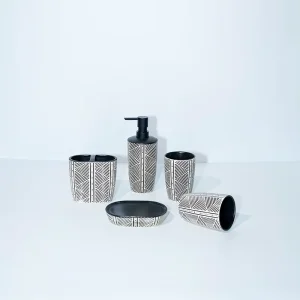
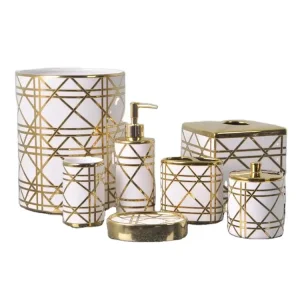
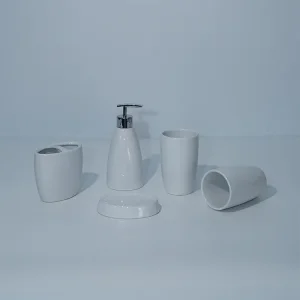

Brazil represents the largest consumer market for construction materials and home decor in Latin America. The sanitaryware and bathroom accessories industry in Brazil is shaped by rapid urban development, a post-pandemic home improvement boom, and a growing consumer focus on environmental sustainability. Across metropolitan centers like São Paulo, Rio de Janeiro, and Belo Horizonte, real estate developers and retail buyers are increasingly prioritizing aesthetic appeal and functional longevity.
For decades, the Brazilian market relied heavily on basic plastic and steel installations. However, modern Brazilian architectural trends favor organic materials, bringing ceramics and porcelain to the forefront. These materials offer unmatched defense against tropical humidity. This change is particularly visible in high-humidity coastal regions like Salvador, Recife, and Fortaleza, where salt air and high moisture levels degrade low-quality metal finishes quickly. High-density ceramic accessories fired at extreme temperatures avoid the typical pitting, rust, and surface deterioration associated with traditional materials in these areas.
Furthermore, the Brazilian sanitaryware market operates under strict localization guidelines. Standardized dimensions, compatibility with national plumbing hardware (e.g., ABNT standards), and specific color coordination dictate purchasing decisions. Suppliers who fail to align with local design trends or do not offer customizable options face major barriers to entry.
Specially formulated stoneware and Dehua white clay fired at 1300°C resist the extreme humidity typical of Brazil's coastal states.
OEM/ODM designs engineered to fit local Brazilian pump setups and standard bathroom vanity dimensions perfectly.
Streamlined logistics to handle Mercosul customs regulations, minimizing transit times and administrative delays at Brazilian ports.
On a global scale, the bathroom accessories segment has shifted from low-cost utility components to wellness-oriented designs. Consumers look for products that transform home bathrooms into spa-like spaces. This visual focus has fueled demand for stoneware, marble-textured ceramics, and matte finishes.
However, global supply chain volatility has forced buyers to evaluate manufacturer capabilities more closely. Relying solely on local assembly in Brazil is often cost-prohibitive due to high domestic utility fees, material shortages, and labor taxes. Chinese manufacturing centers remain crucial for meeting volume demands while keeping quality high.
Advanced automation, raw material sourcing, and clustered industrial supply chains allow Chinese factories to produce premium ceramic items at a lower unit cost than local Brazilian options. For instance, importing ready-to-sell ceramic ensembles avoids the high raw material costs and casting challenges faced by domestic factories in Brazil.
How advanced manufacturing methods and geographic advantages support bulk supply for Latin American markets.
Located in Dehua, the historic porcelain capital of China, Fujian Jiashun Arts & Crafts Corp., Ltd. (founded on January 17, 2005) has developed a highly efficient production environment. Over more than a decade and a half, the company has integrated traditional ceramic craftsmanship with modern manufacturing technology.
With a staff of over 200 workers—including 40+ engineering and management experts—our facility operates two primary ceramic and arts-and-crafts production lines. These lines are powered by two modern intelligent electric control rotary kilns and two automatic grouting lines. This technology ensures reliable output and structural consistency, keeping dimensional tolerances within strict thresholds.
Our facility follows structured 8S management and quality standardization systems. This commitment has earned the factory ISO9001 quality management and ISO14001 environmental certifications. Our export value exceeds USD 5 Million annually, proving our capability to supply large-scale hospitality, commercial, and residential projects throughout Brazil and South America.
| Production Indicator | Jiashun Factory Benchmark | Brazilian Market Benefit |
|---|---|---|
| Firing Kiln Control | Dual Intelligent Electric Rotary Kilns | Consistent glaze and shape control |
| Casting Process | Dual Automated Grouting Lines | Precise dimensions, high-volume speed |
| Material Quality | High-Fired Kaolin Stoneware | Zero absorption, prevents mildew in bathrooms |
| Quality System | 8S Management & ISO9001 | Consistent quality across container orders |
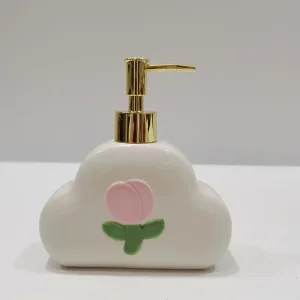
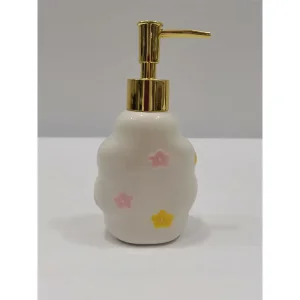
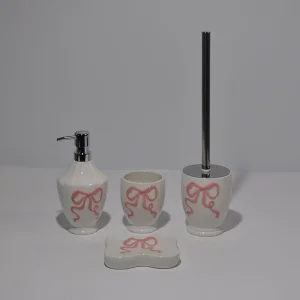
Versatile cloud patterns and classic bow motifs engineered with easy-clean glazes, perfect for high-traffic environments in Brazil.
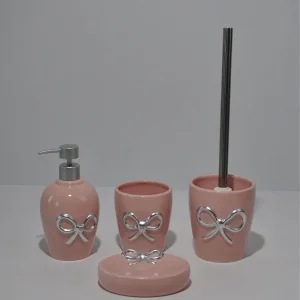
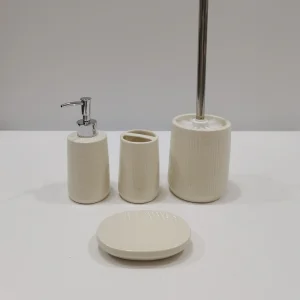
In Brazil, the bathroom is not just a utility space. The "Lavabo" (powder room or guest bathroom) is often a design showpiece in residential homes. Because guest bathrooms are visible to visitors, home builders invest in premium accents to make a positive impression.
Meanwhile, the commercial sector—including luxury boutique hotels in Rio de Janeiro, offices in São Paulo, and eco-resorts in Bahia—demands durable materials that can handle high guest turnover. The table below outlines localized application requirements:
Premium residential designs favor metallic accents, marble-pattern stoneware, and unique textures. Homeowners look for cohesive sets containing soap dispensers, toothbrush holders, vanity trays, and cotton jar containers. These sets help declutter countertops while adding visual interest.
Platforms like Mercado Livre, Magazine Luiza, and Tok&Stok need versatile collections with attractive packaging. The product line must include varied aesthetics—from natural woodgrain styles to pastel finishes—to appeal to different customer profiles.
In hotels, accessories must be easy to clean. Liquid soap dispensers need reliable, clog-free pump systems that can handle high-viscosity sanitizers. Fired stoneware is the preferred material because it does not discolor when exposed to cleaning chemicals or sanitizing sprays.
Modern commercial builds prioritize LEED-certified and green components. Jiashun's award-winning technology, which recycles waste tile clay to produce high-grade ceramics, helps developers earn environmental points for eco-conscious building projects.
Importing home products into Brazil requires navigating specific tariff structures (like the Mercosul Common External Tariff) and meeting clear quality expectations. Professional B2B buyers should evaluate manufacturers against several key performance indicators:
Bathroom glazes must withstand continuous exposure to acidic soaps, strong disinfectants, and heavy cleaning routines without fading or pitting.
Advanced stoneware bases must resist chipping and impact, reducing replacement costs in high-volume hospitality properties.
Products must feature non-toxic glazes that meet international safety standards, ensuring safe everyday contact for users.
Fujian Jiashun Arts & Crafts Corp., Ltd. addresses these challenges through dedicated quality assurance protocols. Our production lines feature in-line inspection checkpoints that check for micro-cracks, pinholes, and uneven glaze coverage before firing. We also perform post-firing inspection steps to ensure color consistency across production batches. This process minimizes color shifts, which is a common issue for major projects ordering hundreds of suites at a time.
The ceramics industry is evolving toward greener, more efficient manufacturing techniques. Traditional kiln operations rely heavily on fossil fuels, creating high emissions. In contrast, Dehua’s modern industrial zones utilize clean energy sources.
Jiashun Arts & Crafts is proud to be a pioneer in sustainable production. We received the Third Prize of the "Science and Technology Award" for our "Waste black tile recycling and production of high-grade daily porcelain technology." This method converts waste clay and broken tiles back into high-grade porcelain, reducing raw material waste and lowering our overall carbon footprint.
Additionally, our intelligent rotary kilns feature automated thermal sensors that adjust temperature profiles dynamically. This innovation reduces energy use by up to 20% compared to older static tunnel kilns, while helping to ensure uniform firing.
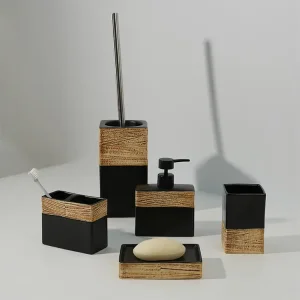
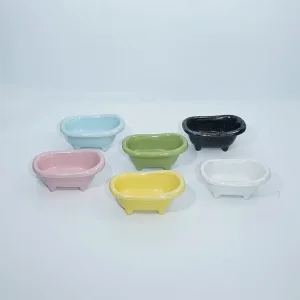
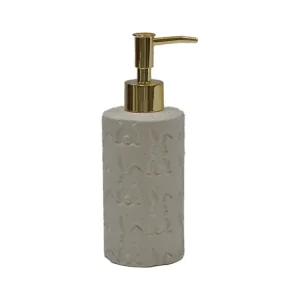
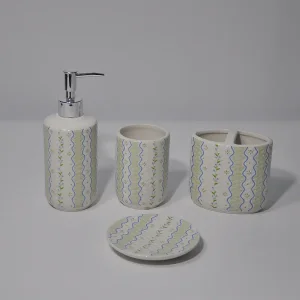
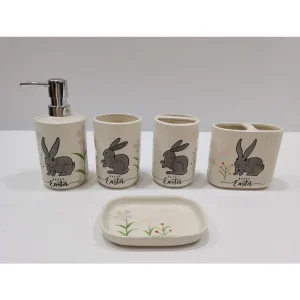
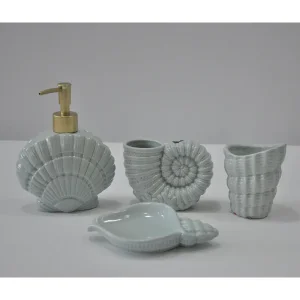
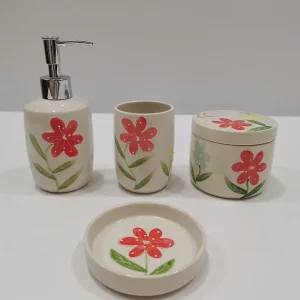
Explore our curated collections, featuring diverse coastal shell designs and rustic embossed reliefs to suit every bathroom interior.
Expert answers to common questions about importing bathroom products into the Brazilian market.
For standard custom designs, the sample production window is 7 to 15 days. Once samples are approved, mass production takes 45 to 60 days, depending on order size. This timeline allows for casting, firing in our electric rotary kilns, glazing, and passing our final quality inspection protocols.
We use custom drop-tested packaging for all ocean freight shipments. Each ceramic item is wrapped in custom-molded drop-resistant foam inside reinforced inner boxes, which are then packed into Master Cartons. For bulk B2B container shipments to ports like Santos or Paranaguá, we secure the cartons on pallets with shrink wrap to prevent shifting in transit.
Yes. Our products comply with sanitaryware standards for lead and cadmium content. We provide full documentation—including test reports, bills of lading, and custom commercial invoices—to help ensure smooth customs clearance through Siscomex.
Our standard MOQ for custom-molded designs is 1,000 units. For standard items featuring custom decals or logos, we can support smaller initial orders of 500 sets to help partners test new designs in the Brazilian market.
Dehua ceramics are fired at temperatures exceeding 1300°C. This high-heat firing process produces a non-porous surface with near-zero water absorption. Unlike plastics, which can discolor, or metals, which can rust in humid coastal areas, our ceramic products retain their original finish and structural integrity for years.
 JIASHUN